For several years, the global conversation around open banking and open finance has largely centred on access to data.
The focus was on opening APIs, increasing competition, enabling innovation and giving consumers greater control over their financial information. Regulators and policymakers around the world concentrated on creating frameworks that would encourage participation and stimulate digital transformation across financial services. But the market is now entering a different phase.
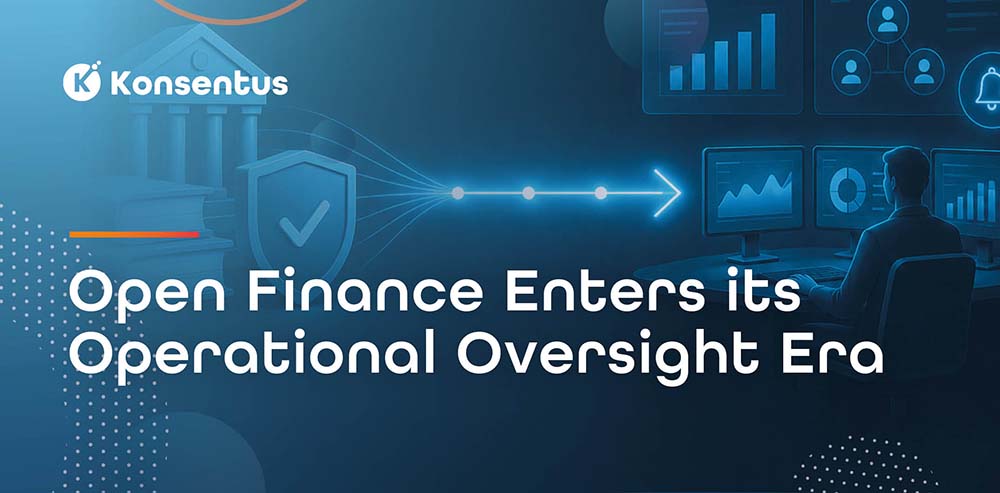
Across multiple regions, the conversation is shifting away from whether data should be shared towards how ecosystems can operate safely, consistently and at scale. Increasingly, regulators are focusing on operational oversight, participant supervision, licensing, consent management, security, trust and accountability. In other words, open finance is maturing.
Recent developments in Canada, Saudi Arabia, the UAE and Vietnam – with Colombia also moving towards a more formal open finance framework, all point in the same direction: open ecosystems are becoming part of critical financial infrastructure and that changes the nature of regulatory expectations.
Open finance is becoming operational infrastructure
One of the clearest signals of this shift can be seen in Canada. The Canadian Government’s consumer-driven banking framework is designed to support innovation, improve financial outcomes and enable secure consumer-permissioned data sharing across financial services. According to the Government of Canada, the framework is intended to create “a safe and secure system for consumers and small businesses to share their financial data with service providers of their choice.”
At the same time, regulatory oversight is becoming more formalised. Legal analysis from DLA Piper notes that responsibility for supervising participants and monitoring the market is shifting towards the Bank of Canada, reinforcing the idea that consumer-driven banking is increasingly being treated as part of the country’s core financial infrastructure rather than simply an innovation initiative.
This evolution is significant because it reflects a broader global change in regulatory thinking. Regulators are now asking operational questions:
- Who is accessing data?
- What permissions do they hold?
- How can those permissions be verified in real time?
- How are participants supervised across the ecosystem?
- How can institutions evidence compliance and operational decision-making?
These are no longer theoretical policy discussions. They are operational requirements.
The Middle East is moving beyond experimentation
A similar trend is emerging across the Middle East. In Saudi Arabia, the Saudi Central Bank (SAMA) continues to move open banking from sandbox experimentation into a formal licensing environment. Recent commentary from Clyde & Co highlights the introduction of a dedicated licensing framework for open banking providers, reinforcing the market’s transition from pilot activity into regulated operational infrastructure.
The Saudi Press Agency has also confirmed that licences are being granted following the successful completion of SAMA’s regulatory sandbox programme.
Similarly, the UAE is moving rapidly towards operational open finance. Abu Dhabi Islamic Bank (ADIB) recently became the first UAE bank licensed as a Third-Party Provider under the Central Bank’s AlTareq Open Finance framework. According to The Paypers, the licence enables customer-permissioned account aggregation and data sharing across participating financial institutions.
ADIB’s own explanation of the AlTareq framework reinforces another important point: the ecosystem is built around explicit customer consent and secure operational participation between regulated entities. Again, the emphasis is no longer simply on API connectivity. The focus is increasingly on governance, participant assurance, operational resilience and trusted market participation.
Colombia highlights the importance of operational readiness
Latin America is also moving in this direction. Colombia continues to progress towards a more formal open finance framework, with industry participants increasingly focusing on how operational models, onboarding structures and ecosystem governance will function in practice.
That matters because, as ecosystems expand beyond banks to include fintechs, retailers, insurers, lenders and other participants, operational complexity increases significantly. For open finance to support inclusion at scale, these capabilities must be cost-efficient and accessible to as many financial service providers as possible, whether supervised or non-supervised. Trust, onboarding, verification, consent management and monitoring should not become barriers to participation but shared infrastructure that enables wider, safer access to the ecosystem.
Participants need confidence that counterparties are legitimate, appropriately authorised and continuously monitored. Regulators need assurance that operational controls are functioning consistently across the market. Consumers need confidence that consent, security and accountability are properly managed. The operational layer, therefore, becomes just as important as the data-sharing layer itself.
Vietnam reflects a wider global trend
Vietnam provides another useful perspective on global trends. While Vietnam’s current focus is broader digital financial transformation rather than formal open finance licensing, the country’s rapid digitisation highlights why scalable operational infrastructure is becoming increasingly important.
According to Vietnam News, more than 95% of Vietnamese credit institutions have already implemented or are implementing digital transformation strategies, while nearly 80% of financial transactions are now conducted through digital channels.
As digital ecosystems expand, institutions must manage onboarding, authentication, permission verification, consent handling, fraud prevention and ongoing participant monitoring across increasingly interconnected networks. Without a scalable trust infrastructure, those ecosystems become harder to govern, supervise and secure.
The industry is entering its operational maturity phase
Open banking’s first phase was largely about proving that secure data-sharing could work. The next phase is about proving that large-scale ecosystems can operate safely and sustainably over time. That requires a shift in focus.
The future of open finance will not be defined solely by APIs or data access standards. It will increasingly be shaped by the operational frameworks that sit behind them; the mechanisms that establish trust, verify permissions, support supervision and enable participants to interact safely at scale.
In many ways, this mirrors the natural evolution of other critical financial infrastructures. As markets mature, oversight deepens. As participation grows, operational accountability becomes more important. And as ecosystems become more interconnected, trust becomes foundational.
Across Canada, Saudi Arabia, the UAE and Vietnam – and increasingly across emerging open finance markets globally – the direction of travel is becoming clearer. Open finance is no longer just a policy ambition. It is becoming operational infrastructure.
As open finance and smart data ecosystems move from policy ambition to operational oversight, organisations will need to ensure their trust, verification and access-control frameworks are ready to support secure participation at scale.
Our team is closely monitoring open banking, open finance and open data developments globally, and would be pleased to support you in assessing your readiness, strengthening third-party verification controls and shaping a resilient strategy for the years ahead.

Brendan Jones
COO Konsentus