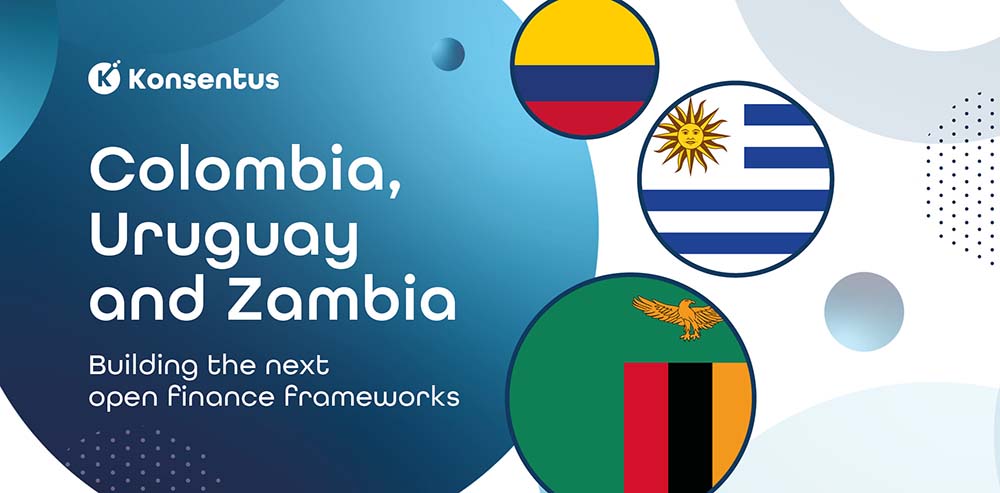
Recent developments in Colombia, Uruguay and Zambia point to a significant shift in open finance.
Across three very different markets, regulators are moving beyond policy ambition and into the practical design of open finance ecosystems. Colombia has started technical discussions for the implementation of mandatory open finance, Uruguay has presented a draft bill to create an Open Finance System, and Zambia has published a position paper setting out its proposed approach and phased implementation roadmap.
Each market has its own policy context, institutional structure and priorities. But together, they show a clear direction of travel: open finance is becoming a matter of regulated infrastructure, not just data access.
The question is no longer whether customer-consented data sharing can support innovation, competition and inclusion. The more important question is how open finance can be implemented in a way that is trusted, governed, operationally viable and capable of scaling.
Three markets, one common direction
Colombia is moving from regulation into implementation. Following the introduction of its mandatory open finance framework, the Financial Superintendency of Colombia (SFC) has begun technical meetings with supervised and non-supervised actors to gather information for the implementation schedule and definition of standards.
Mandatory open finance cannot be delivered by regulation alone. It requires coordinated implementation across the ecosystem. Colombia’s approach recognises that standards, sequencing and market readiness need to be developed with market participants, not imposed in isolation from them.
Uruguay is at a different stage. The Central Bank of Uruguay has presented a draft bill for the creation of an Open Finance System. The proposed framework supports the secure, consented sharing of financial and payments data, as well as the initiation of operations, including payments. It also allows for progressive expansion into other sectors and data types as the market and regulation mature.
What is notable in Uruguay’s proposal is the emphasis on the system as a regulated, interoperable and interconnected infrastructure. The draft places user control, informed consent, security, resilience, participant roles, technical standards and governance at the centre of the model. It also reflects lessons from other jurisdictions, including the UK, the EU, Mexico, Peru, Australia, India, Chile and, in particular, Brazil.
Zambia provides a third perspective. The Bank of Zambia’s position paper sets out open finance as a way to expand access, promote competition, drive innovation and improve customer choice. It also recognises practical barriers, including fragmented bilateral data-sharing arrangements, infrastructure gaps, provider readiness, consumer awareness, legal clarity and common standards.
Its roadmap is phased. It starts with governance, market engagement, regulatory framework development and support for the data-sharing ecosystem, before moving towards pilots and wider participation. The paper describes a pathway from limited mandatory data sharing to a full-scale mandatory data-sharing regime.
Different routes, shared questions
Colombia, Uruguay and Zambia are not following identical paths. Colombia is moving into implementation. Uruguay is legislating the framework. Zambia is designing the roadmap.
Colombia’s challenge is operational coordination. With supervised and non-supervised actors involved, the ecosystem will need clear processes for standards development, participant onboarding, verification, monitoring and ongoing oversight.
Uruguay’s draft bill gives the Central Bank a central role in regulating, supervising and overseeing the Open Finance System. It also provides for participant roles, registration and authorisation, technical and operational standards, consent and revocation, interoperability and progressive implementation.
Zambia’s readiness-led approach recognises both the opportunity of open finance and the gaps that must be addressed before full-scale implementation. Its position paper is particularly explicit about the need to build meaningful participation and trust together, including through governance, cost and incentive design, data-sharing standards, consumer experience standards, liability and recourse.
The common thread is that all three markets are treating open finance as a system-level reform. The objective is not simply to enable individual data transfers between institutions. It is to create a framework through which trusted participants can exchange data securely, consistently and under defined rules.
Learning from other markets
Another interesting feature is how openly these markets draw on international experience. The UK and Europe are important reference points, but they are not the only models being studied. Brazil has become an influential example for countries looking to move beyond open banking into broader open finance. Zambia’s position paper also compares mandatory models with more voluntary or emerging frameworks.
There is no single template for open finance. Each market needs a model that reflects its legal system, financial market structure, digital infrastructure, regulatory capacity and inclusion objectives. However, one lesson appears universal: access rights alone are not enough.
Europe demonstrates why. The European regulation underpinning open banking (PSD2) created an important foundation for access to payment account data and payment initiation, but implementation across markets was uneven. Differences in API quality, participant identification, supervision, user experience and operational practices created friction.
PSD2’s successor, PSD3 and PSR package, is now the more concrete near-term reference point in Europe, with the EU moving towards a revised payments framework that strengthens open banking, fraud prevention, consumer protection and access conditions. Proposed European open finance regulation (FiDA) points to a broader vision: customer-controlled data access extending beyond payments into wider financial services. Whether that vision is delivered in its current form remains to be seen, but it is already shaping thinking about trust, permissions, participation and data-sharing infrastructure.
For emerging open finance markets, Europe provides a valuable lesson. It is far easier to design trust infrastructure into the system from the beginning than to retrofit it later.
Designing trust into the system
The experience of more mature open banking markets has shown that access rights are only the beginning. Once participants begin exchanging customer-consented data at scale, the practical questions quickly become more complex.
How does a data holder know that a third party is authorised to request access? How are roles recorded and updated? How is consent linked to the right participant, service and data set? How are participants monitored after onboarding? These questions determine whether an open finance ecosystem can operate safely and efficiently.
This is why Colombia, Uruguay and Zambia are useful examples. Each market is considering open finance not only as a legal right or a technical API programme, but as an operating environment. Colombia’s technical meetings point to implementation sequencing and market coordination. Uruguay’s draft bill places participant roles, registration, authorisation, security and progressive implementation within the legal framework. Zambia’s position paper highlights the need to move beyond fragmented bilateral arrangements towards common standards, governance and shared trust.
Open finance frameworks need to define not only what data can be shared, but how trusted access will work in practice. That means establishing reliable ways to identify participants, validate permissions, manage consent, monitor access and support accountability.
Without this layer, every institution is left to solve the same questions individually. That increases duplication, slows onboarding, creates inconsistent user experiences and makes it harder for regulators to maintain visibility.
The next phase of open finance
The debate is no longer limited to the benefits of data sharing: better credit assessment, more personalised services, improved financial inclusion, greater competition, lower friction and more innovation. The next challenge is implementation.
For open finance to deliver on its promise, ecosystems need to know who is participating, what they are authorised to do, which data they can access, how consent has been granted, how it can be withdrawn, how activity is monitored and how accountability is enforced.
At Konsentus, we see this across markets at different stages of development. Whether in Europe, Latin America, Africa or elsewhere, the same principle applies: open finance will only scale when regulation, governance, operations and technology are designed to work together.
APIs create the connection. Consent creates the permission. But trust is what makes participation sustainable.
The future of open finance will not be defined by data access alone. It will be defined by the ability to build trusted ecosystems where participants can be verified, access can be governed, users remain in control and innovation can scale safely.
Get in touch to discuss how Konsentus can support your open finance strategy with the trust infrastructure, participant verification and operational oversight needed to scale securely.

Brendan Jones
COO Konsentus